Abstract
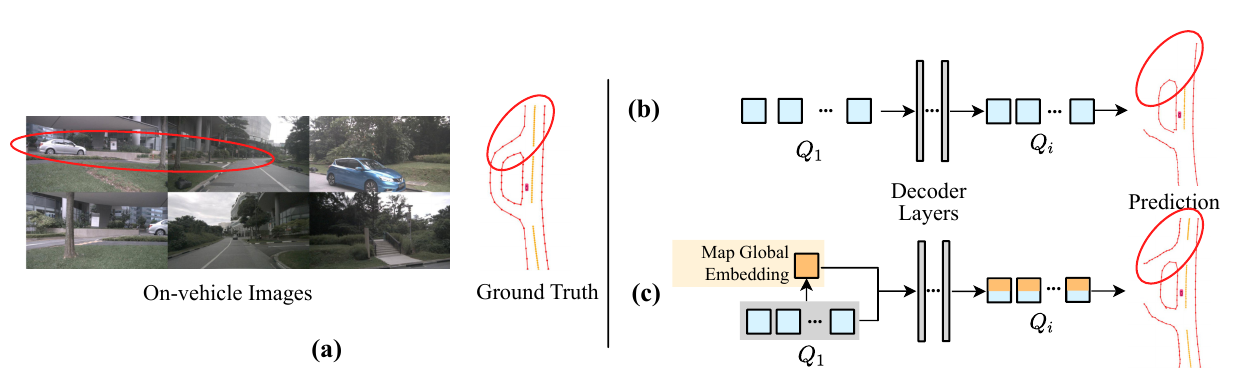
The online construction of vectorized high-definition (HD) maps is a cornerstone of modern autonomous driving systems. State-of-the-art approaches, particularly those based on the DETR framework, formulate this as an instance detection problem. However, their reliance on independent, learnable object queries results in a predominantly local query perspective, neglecting the inherent global representation within HD maps. In this work, we propose MapGR (Global Representation learning for HD Map construction), an architecture designed to learn and utilize a global representation from queries. Our method introduces two synergistic modules: a Global Representation Learning (GRL) module, which encourages the distribution of all queries to better align with the global map through a carefully designed holistic segmentation task, and a Global Representation Guidance (GRG) module, which endows each individual query with explicit, global-level contextual information to facilitate its optimization. Evaluations on the nuScenes and Argoverse 2 datasets validate the efficacy of our approach, demonstrating substantial improvements in mean average precision (mAP) compared with leading baselines.
Method
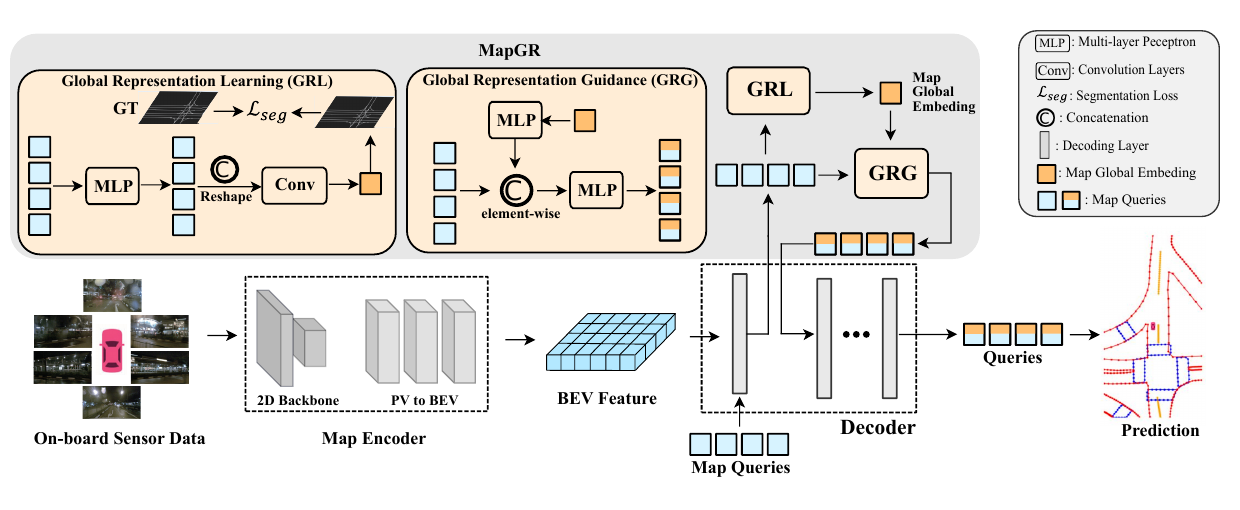
MapGR is a plug-in for DETR-like vector map decoders. It adds global supervision and context while leaving the underlying map encoder and prediction heads intact.
Global Representation Learning (GRL)
GRL aggregates all local map queries into one global embedding and predicts a holistic rasterized map. Segmentation supervision aligns the full query distribution with the ground-truth map.
Global Representation Guidance (GRG)
GRG encodes the predicted map-level representation and fuses it into every local query, giving each query explicit scene-wide context during subsequent decoding.
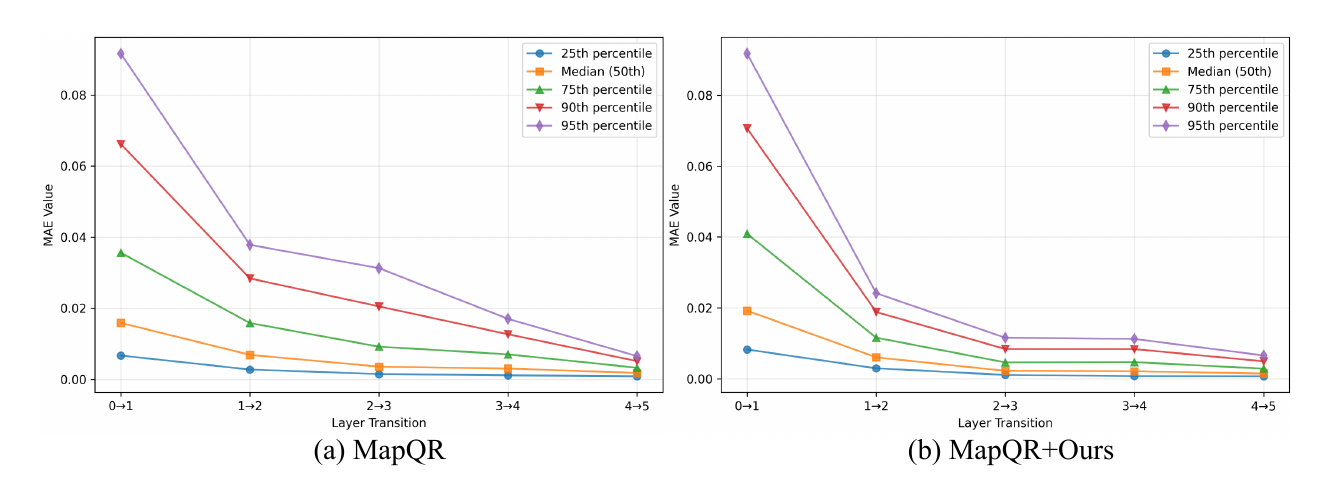
Plug-and-play integration. The modules integrate with MapTR, MapTRv2, and MapQR. Applying them in the first two decoder layers provides the best balance between global distribution learning and final instance convergence.
Results
MapGR improves all three evaluated DETR-like baselines on nuScenes and Argoverse 2, covering lane dividers, pedestrian crossings, and road boundaries.
| Dataset | Baseline | Epochs | mAP1 | mAP2 |
|---|---|---|---|---|
| nuScenes | MapTR | 24 | 27.3 → 31.2 +3.9 | 50.3 → 54.5 +4.2 |
| MapTRv2 | 24 | 37.2 → 41.1 +3.9 | 61.5 → 65.0 +3.5 | |
| MapQR | 24 | 42.1 → 45.3 +3.2 | 65.3 → 68.1 +2.8 | |
| Argoverse 2 | MapTR | 6 | 33.7 → 35.3 +1.6 | 57.8 → 58.9 +1.1 |
| MapTRv2 | 6 | 38.4 → 39.6 +1.2 | 64.7 → 65.6 +0.9 | |
| MapQR | 6 | 42.1 → 42.9 +0.8 | 65.1 → 66.0 +0.9 |
With the longer 110-epoch schedule, MapGR improves MapTR by 4.9 mAP2 on nuScenes.
Efficiency
Across all three baselines, MapGR retains nearly the same throughput. The paper reports approximately 1% runtime overhead (at most 1.2 ms) while adding 4-23% parameters, depending on the baseline.
| Method | Params | FPS |
|---|---|---|
| MapTR | 47.5M | 24.2 |
| + MapGR | 58.5M | 23.8 |
| MapTRv2 | 56.1M | 19.6 |
| + MapGR | 67.1M | 19.4 |
| MapQR | 225.4M | 17.9 |
| + MapGR | 236.4M | 17.7 |
Qualitative Results
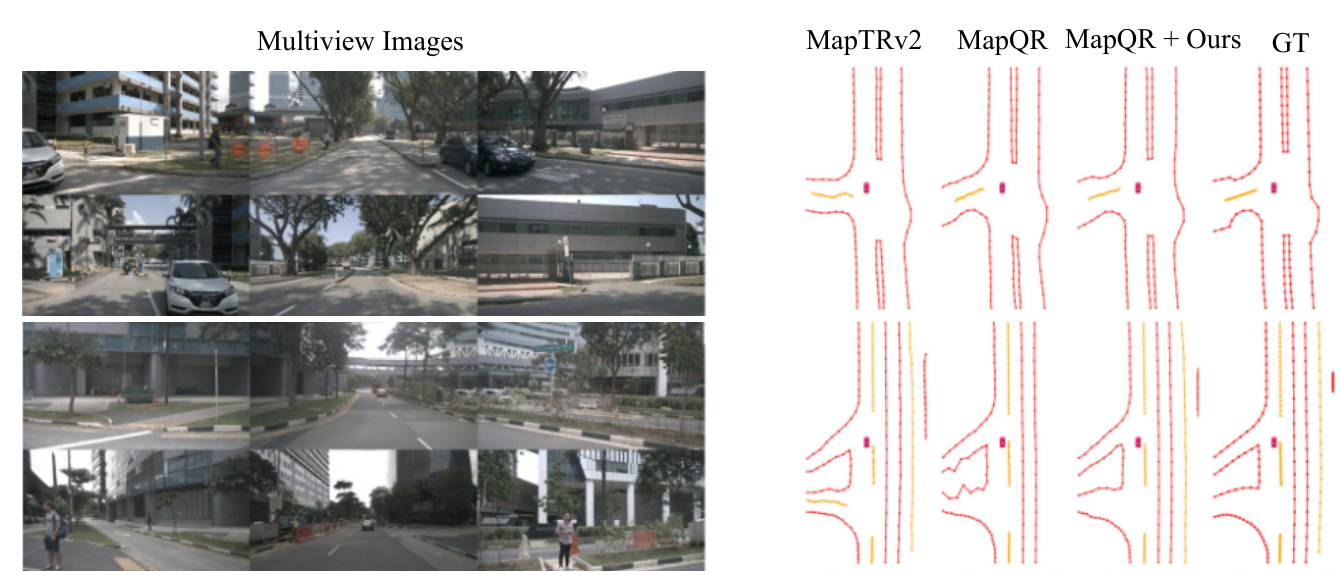
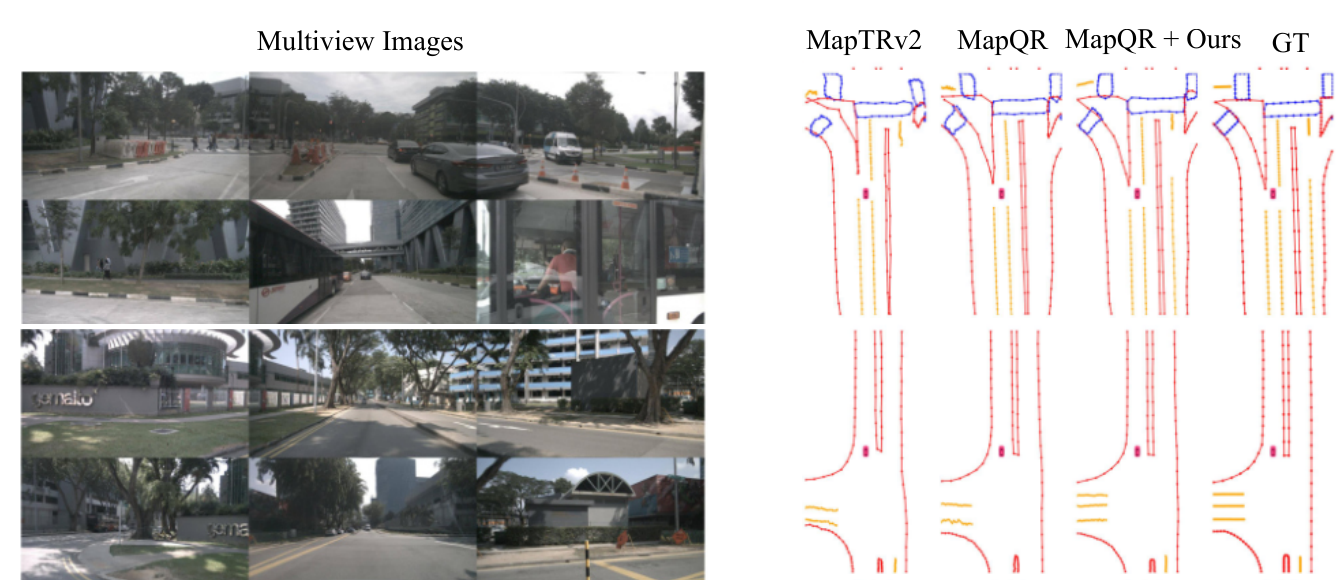
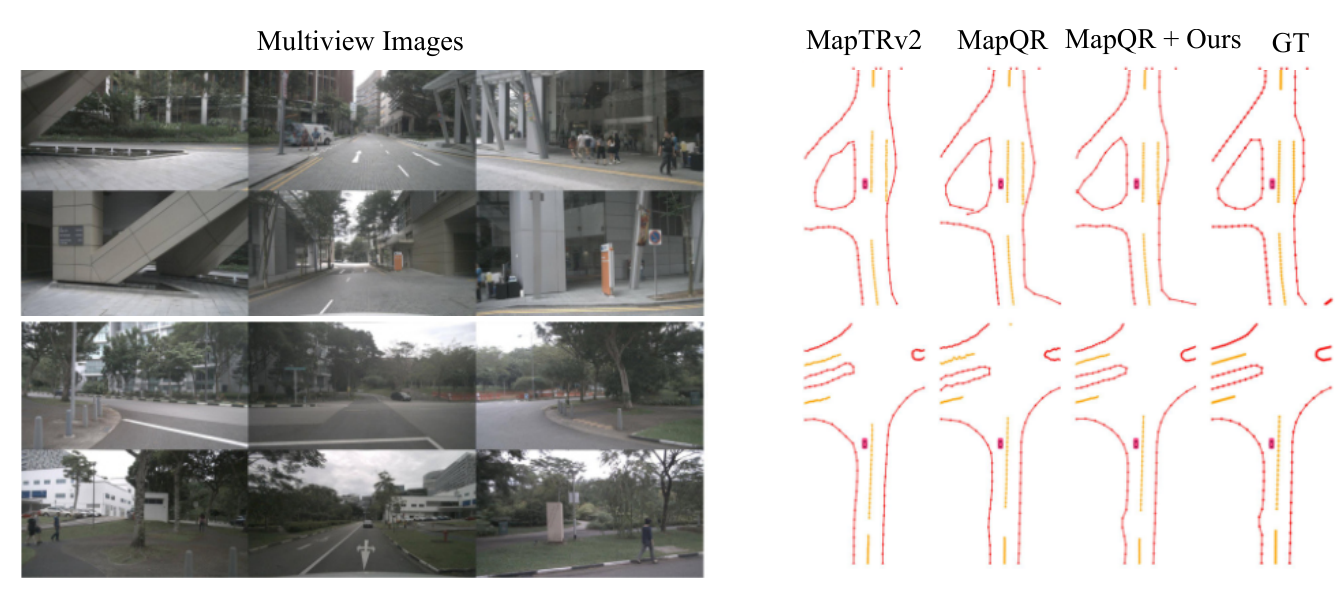
Across six nuScenes examples, MapGR recovers more complete boundaries, parallel lanes, pedestrian crossings, and junction branches. Each row compares MapTRv2, MapQR, MapQR with MapGR, and ground truth.
Analysis
BibTeX
@inproceedings{qiu2026mapgr,
  title     = {Learning Global Representation from Queries for Vectorized {HD} Map Construction},
  author    = {Qiu, Shoumeng and Li, Xinrun and Long, Yang and Xue, Xiangyang and Ojha, Varun and Pu, Jian},
  booktitle = {International Conference on Machine Learning (ICML)},
  year      = {2026}
}